School Meals
The school operates a cafeteria system at which the children have a choice of school meal. School dinner money should be paid via parent-pay or via school on a Monday morning in the envelopes provided. The cost of a school meal is £2.40 per day, (£12 per week).
If children would like to change from school meals to packed lunch this can ONLY be done at the beginning of a half term. Changes from packed lunch to school dinner can be undertaken at any time. The office must be informed of all changes in writing.
The Government currently give all pupils in Reception, Year 1 and Year 2 a Free School Meal. During the lunch break a team of Supervisory Assistants look after the children. Children must follow the instructions of the assistants. Children are expected to give the same respect to all adults working with them, whether they are teaching or support staff.
Please Click Below to access your Arbor parent portal;

Menus
School Dinner Menu Week 1
School Dinner Menu Week 2
School Dinner Menu Week 3
School Dinner Menu Week 4
Free School Meals
- all children in Reception, Year 1 and Year 2 receive universal infant free school meals;
- from the beginning of the 2026–2027 academic year, children whose households receive Universal Credit qualify for free school meals regardless of household earnings;
- other qualifying circumstances may also apply;
- eligibility must still be claimed and verified;
- families of infant children should still apply for benefits-related free school meals because successful registration can attract additional funding for the school.
Link to eligibility check for FSM Free school meals | Middlesbrough Council
Allergies and special dietary requirements
- We are committed to ensuring that children with food allergies, intolerances, medical conditions and other dietary requirements can eat safely at school.
- Parents and carers must inform the school office of any dietary requirement before their child has a school meal. This includes:
- diagnosed food allergies;
- food intolerances;
- medical conditions that affect a child’s diet;
- religious or cultural dietary requirements; and
- other specific dietary needs.
- Parents and carers should provide complete and up-to-date information about their child’s needs. Where appropriate, the school or catering provider may request further information from a healthcare professional before a special menu can be provided. An individual healthcare plan may also be agreed where a child has a medical condition or allergy that could require emergency treatment.
- Information about the 14 regulated allergens is available for the food served by offer. Parents and carers who require allergen information or wish to discuss a menu should contact the school office before ordering a meal.
- Although appropriate procedures are followed when preparing and serving food, meals are produced in environments where a range of allergens may be present. We cannot therefore guarantee that any meal or area of the school is completely free from a particular allergen. Parents and carers should not rely solely on the published menu, as ingredients, recipes or products may occasionally change.
Please notify the school immediately if:
- your child is diagnosed with a new allergy or medical condition;
- their dietary requirements change;
- their prescribed medication changes; or
- updated medical advice is received.
- Children must not share or exchange food. Any prescribed emergency medication, including adrenaline auto-injectors, must be supplied to the school in accordance with the school’s medical-needs procedures.
- For advice, allergen information or to request a special diet, please contact the school office.
How lunchtime works
Our lunchtime arrangements are designed to ensure that children are supported while eating and can enjoy a safe, positive transition into their lunchtime play.
| Phase | Lunchtime arrangements |
| Early Years Foundation Stage (EYFS) | Children are accompanied to lunch and supervised by members of staff throughout their mealtime. Staff support children with their food, encourage positive routines and help them become increasingly independent. |
| Key Stage 1 | Children are taken to the dining hall by members of staff before going outside to play. Staff supervise and monitor children while they are eating and provide support when required. |
| Key Stage 2 | Children use a coloured-band system to choose when they would like to go to the dining hall. This helps to manage the flow of children while giving them greater independence and flexibility during lunchtime. Staff supervise and monitor children throughout their meal. |
For all children
- Fresh drinking water is available throughout lunchtime.
- Staff monitor children while they are eating and offer support when needed.
- Children are encouraged to eat well, demonstrate good table manners and develop age-appropriate independence.
- Staff will respond if a child is having difficulty eating or regularly appears not to be eating enough.
- After eating, children access our OPAL play provision, where they are supervised by staff across the available play areas.
Packed Lunches
We ask parents and carers of children on packed lunches to provide a balanced lunch that will give their child the energy and nutrition needed for the school day.
A balanced packed lunch might include:
- a sandwich, wrap, pasta, rice or another suitable main item;
- fruit and/or vegetables;
- a yoghurt or other dairy alternative;
- a healthy snack; and
- a still drink or refillable bottle of water.
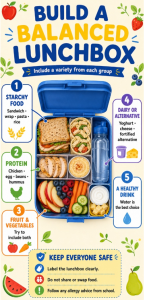
Packed lunches should be securely closed and clearly labelled with the child’s name. Parents and carers should not send glass containers, fizzy drinks, energy drinks or excessive amounts of sweets and confectionery.
Allergies and food safety
Some children at Sunnyside have serious food allergies. To help keep everyone safe:
- children must not share or exchange food, drinks, utensils or food containers;
- parents and carers must inform the school office about any diagnosed allergy, food intolerance, coeliac disease or other medical dietary requirement;
- packed lunches for children with allergies should be clearly labelled;
- food should remain in its original packaging where allergen information may need to be checked;
- unlabelled food should not be brought into school for sharing;
- families should follow any specific requests made by the school to reduce an identified allergy risk.
We ask families to avoid including nuts and nut-based products, such as loose nuts and peanut butter, in packed lunches.
The school manages allergy risks through individual healthcare arrangements, staff training, appropriate supervision and sensible controls around food. Any restrictions will be based on the needs of individual children and communicated to families when necessary.
If you are unsure whether a particular food is suitable, or your child has a special dietary requirement, please contact the school office before sending it into school.